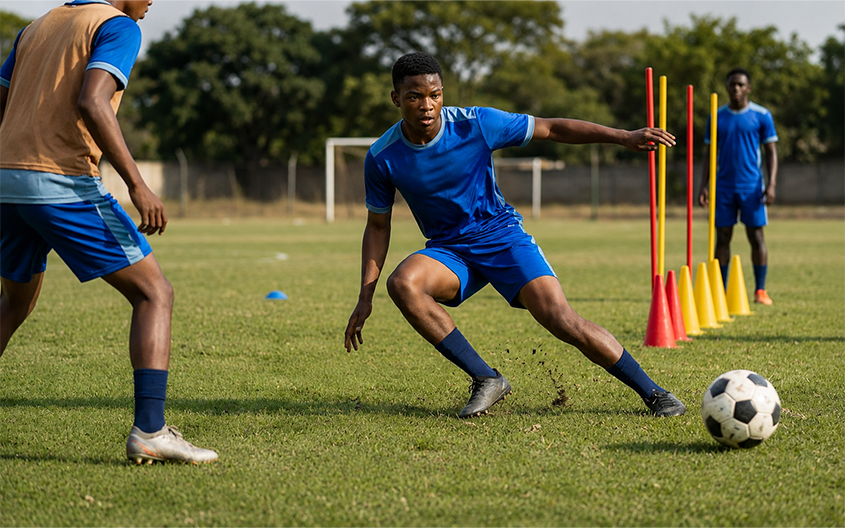
In the world of youth football recruitment and player development, “speed” is often the most talked-about physical trait. Parents and scouts look for the player who can outrun everyone in a footrace, assuming that raw pace is the golden ticket to professional success. However, at Silver Studs FC, we look deeper. We distinguish between “Track Speed” and “Game Agility.”
In a ninety-minute match, a player rarely runs in a straight line for more than twenty yards. Football is a game of stops, starts, pivots, and lateral shifts. It is a game played in tight spaces where the ability to change direction in a split second is far more valuable than the ability to run a fast 100-metre sprint. This is what we call The Anatomy of Agility.
Defining Agility: The Thinking Athlete’s Weapon
To the untrained eye, agility looks like quick feet. To the professional coach, agility is a complex interaction between the brain and the body. We define agility as the ability to change initial body position or direction rapidly and accurately in response to a stimulus.
That last part – in response to a stimulus – is what separates agility from simple “change of direction” drills. On our training pitches in Harare, we don’t just want players to run around cones. We want them to react to a moving ball, a teammate’s call, or an opponent’s tackle. True agility is “reactive.” It is the physical manifestation of a player’s ability to read the game and adjust their body accordingly.
The Three Pillars of Agility
To build an agile athlete within our 12-hour weekly training cycle, we break the concept down into three mechanical pillars: Perception, Deceleration, and Re-Acceleration.
1. Perception and Decision-Making
Before the feet can move, the eyes must see and the brain must process. This is the “Cognitive” side of agility. If a winger sees a fullback over-committing to one side, their brain signals a change of direction. At Silver Studs FC, we use high-tempo drills that force players to scan their environment before they move. If your brain is slow, your feet will follow.
2. The Art of Deceleration
Most injuries in youth football occur when a player tries to change direction but cannot “brake” effectively. Deceleration is the foundation of agility. It requires immense core stability and eccentric leg strength. We coach our players on how to lower their “Centre of Gravity” as they approach a turn. By dropping the hips and taking shorter, “choppy” steps, a player gains the stability needed to pivot without losing balance or risking a knee injury.
3. Re-Acceleration (The First Three Steps)
Once a player has stopped or turned, the race begins again. Agility is only effective if the exit speed is explosive. This relies on what we call “The First Three Steps.” We focus on the “Power-to-Weight” ratio of our athletes, ensuring they have the explosive strength to push off the ground with maximum force.
Agility Across Formations: Positional Needs
Different roles on the pitch require different types of agility. Because we are a boutique academy that focuses on positional play, we tailor our agility work to the specific demands of the modern game.
- The Creative Midfielder: Requires “360-degree Agility.” They must be able to spin out of pressure in any direction. Their agility is built on “swivel hips” and the ability to protect the ball while turning.
- The Modern Fullback: Requires “Lateral Agility.” They spend much of the game shuffling side-to-side to track a winger. Their agility is built on “closed-gate” footwork and recovery speed.
- The Centre Forward: Requires “Explosive Sharpness.” Their agility is measured in the two-yard movements inside the penalty box – the ability to “snap” away from a marker to meet a cross.
How We Train Agility: The Silver Studs Methodology
We do not believe in “static” agility. Running through a ladder on the ground is a great warm-up, but it doesn’t make you a better footballer. Our sessions are designed to be Game-Representative.
Mondays: Technical Footwork
During our technical foundation hour, we focus on ball-at-feet agility. This involves tight-space dribbling where the player must move the ball and their body simultaneously. We emphasize “low-profile” movement – keeping the ball close and the centre of gravity lower than the opponent’s.
Wednesdays: Reactive Intensity
This is where we introduce the “Stimulus.” We use drills where players must react to a whistle, a colour-coded gate, or a teammate’s movement. This forces the nervous system to adapt to the unpredictability of a real match.
Saturdays: The Ultimate Test
Match day is the final assessment of agility. We look for players who can stay “light on their feet” even in the 80th minute. This is where our Physical Pillar meets our Psychological Pillar – having the mental focus to maintain perfect movement mechanics when fatigued.
The Role of Core Stability and Balance
You cannot be agile if you are not balanced. At our grounds in Harare, we incorporate “Proprioception” exercises. These are movements that challenge the body’s awareness of its position in space. By strengthening the ankles, knees, and core, we create a “stable platform.”
When a player has a strong core, they can keep their upper body still while their lower body works at high speeds. This “separation” is the hallmark of an elite athlete. It allows a player like a modern playmaker to look one way while their feet are already preparing to move the other way.
Why Agility Prevents Injury
Beyond performance, agility is our greatest tool for Injury Resilience. Many youth ACL and ankle injuries occur because a player’s body is “disconnected” – their brain wants to go one way, but their joints aren’t prepared for the force.
By teaching proper “cutting” techniques (how to plant the foot and align the knee during a turn), we significantly reduce the risk of non-contact injuries. We are not just building faster players; we are building “robust” players who can handle the physical demands of a 12-hour training week.
Conclusion: Mastering the Micro-Movements
In the modern game, space is a luxury. As teams become more tactically compact, the “footrace” is becoming rarer. The players who succeed are those who can win the “micro-battles” – the half-yard of space created by a sharp turn or a sudden stop.
At Silver Studs FC, we want our players to be fast, but more importantly, we want them to be agile. We want them to have the “Technical Grit” to handle the ball and the “Anatomy of Agility” to navigate the tightest spaces on the pitch. Speed might get you to the ball, but agility allows you to do something meaningful once you arrive.
Success is found in the turns, the pivots, and the explosive reactions. That is how we engineer the modern athlete.
You Might Also Like

A professional blueprint for technical, tactical, and mental player growth.

A detailed breakdown of our rigorous twelve-hour weekly training schedule.